
Two people can be saving for exactly the same goal, on exactly the same timeline, and yet one keeps it up all year while the other quietly gives up by March. Often the only difference is the size of the number they told themselves to save — not the total, but the slice. "$500 a month" and "$115 a week" describe an identical annual commitment, but they land in the mind completely differently, and they interact with your paycheck, your budget, and your willpower in different ways. This guide is about that choice: how to convert a savings goal into a weekly, biweekly, or monthly contribution, why smaller-more-frequent amounts are often easier to sustain, and the modest interest edge that comes from putting money to work a little sooner. The Savings Goal Calculator does the conversion instantly; understanding what changes — and what doesn't — when you switch cadences helps you pick the one you will actually keep.
The Same Goal, Three Cadences
Start with the arithmetic, because it is the anchor everything else hangs on. A savings goal is a total amount over a stretch of time; a contribution is that total sliced into equal deposits. The number of slices is the only thing that changes when you switch cadence. Take a common example — a $6,000 goal over one year:
- Monthly: $6,000 ÷ 12 = $500 per month
- Biweekly: $6,000 ÷ 26 = about $231 every two weeks
- Weekly: $6,000 ÷ 52 = about $115 per week
All three deposit the same $6,000 across the year. Scale the goal up or down and the relationships hold: a $3,000 annual goal is $250 monthly, roughly $115 biweekly, and about $58 weekly; a $12,000 goal is $1,000 monthly, about $462 biweekly, and roughly $231 weekly. The total never moves. What moves is how the commitment feels and how well it lines up with the rhythm of your income — and those two things, not the math, decide whether the plan survives.
Why Weekly Feels Smaller
Nothing about the arithmetic favors one cadence, but plenty about human behavior does. A smaller, more frequent number is easier to hold in your head and easier to weigh against a single decision. "$115 this week" maps onto a concrete trade-off you can picture — skip two takeout dinners, or one impulse purchase — whereas "$500 this month" is an abstraction that competes with rent and every other big bill in one lump. Behavioral researchers describe this as a form of narrow bracketing: we manage small, near-term amounts more carefully than large, distant ones.
The forgiveness of frequent saving matters just as much. A weekly saver makes 52 small, low-stakes decisions across the year; if one week goes badly, the damage is $115 and the next week resets the rhythm. A monthly saver makes 12 higher-stakes decisions; a single skipped month is $500 and a bigger dent in momentum, and a bigger dent is harder to recover from psychologically. Frequent small commitments are more forgiving, and forgiving plans are the ones that survive an ordinary, imperfect year rather than collapsing the first time life gets in the way.
Biweekly Saving and Matching Your Pay Cycle
The best cadence is frequently the one that matches how you are paid, because saving is easiest when it happens right after money arrives and before it has a chance to be spent. If your paycheck lands every two weeks — the most common pay schedule for many workers — a biweekly contribution lets you skim a fixed amount off each check the day it clears. There is no waiting, no mental placeholder for a transfer weeks away, no risk that the money is already gone by the time a monthly transfer date rolls around.
Matching cadence to paycheck turns saving from an act of willpower into a piece of plumbing. The same logic applies at every frequency: weekly pay pairs with weekly saving, twice-monthly pay with a semi-monthly split, and a monthly salary with a single monthly transfer the day after payday. When the deposit rides on the same rhythm as your income, you never have to find the money — it is set aside before you notice it is there, which is exactly the state in which saving requires no discipline at all. One caution worth noting: because there are 26 biweekly periods in a year, a biweekly plan quietly delivers two "extra" paychecks' worth of saving compared with a semi-monthly (24-per-year) plan, so don't confuse "every two weeks" with "twice a month" — they are not the same number of deposits.
The Weeks-Per-Month Trap
Here is the conversion mistake that quietly derails plans: assuming a month is four weeks. It feels right, and it is wrong. A year has 52 weeks and 12 months, so the average month is about 4.33 weeks, not 4. If you take a $500 monthly target and simply multiply by four to get a weekly figure, you land on $125 a week — which sounds harmless but actually overshoots. Fifty-two weeks at $125 is $6,500, not $6,000; you would be committing $500 a year more than the goal requires, and wondering why the plan feels heavier than it should.
The reliable method is always to convert through the annual total, never month-to-week directly. Figure the yearly amount first, then divide by 52 for weekly, 26 for biweekly, or 12 for monthly. The honest weekly equivalent of $500 a month is $6,000 ÷ 52 ≈ $115, not $125. Anchoring on the annual total keeps every cadence describing the exact same goal — which is the whole point of switching between them. The calculator handles this conversion for you, but knowing why the "times four" shortcut fails keeps you from setting a target that is silently around 8% too high, or, run the other direction, too low.
A Small Interest Edge for Saving More Often
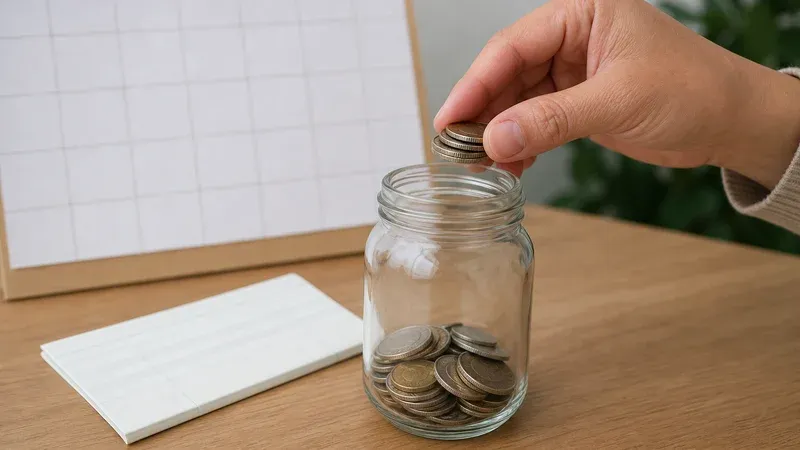
Cadence changes one more thing, gently: when your money starts earning. Deposits that go in more frequently spend more time in the account, so on an interest-bearing balance they earn slightly more than the same annual amount dropped in twelve monthly chunks. Picture two savers targeting $6,000 in a year in a high-yield savings account earning around 4% APY — illustrative, since these rates are variable and move with the wider rate environment. The weekly saver adds about $115 every week, so on average through the year they carry a higher balance than the monthly saver who waits and deposits $500 at a time.
The extra interest is real but modest — on a one-year, $6,000 goal it amounts to only a few dollars over the year, not a reason on its own to choose weekly. The effect grows with the size of the balance and the length of the horizon: on a multi-year goal, contributing more often and letting each deposit start compounding sooner adds up to a more meaningful sum. Treat this as a small tiebreaker, not the headline. The behavioral advantage of a cadence you can actually sustain dwarfs the interest advantage of one you can't keep. For the full picture of how interest reshapes the required contribution over the life of a plan, see our guide on how to build a savings plan.
Which Cadence Should You Pick?
There is no universally correct answer — only the one that fits your income and your habits. A few honest guidelines. Choose weekly if a large monthly number intimidates you, if you tend to spend whatever is sitting in checking, or if you simply find frequent small wins motivating; the steady drumbeat keeps the goal present in your mind. Choose biweekly if you are paid every two weeks and want the cleanest possible link between income and saving, with each deposit riding a paycheck. Choose monthly if your financial life already runs on a monthly cycle of bills and a once-a-month budget review, and you would rather manage one recurring transfer than several.
Many people blend cadences across goals: a small weekly transfer toward a near-term treat, a monthly transfer into the emergency fund. The right choice is the one you will still be running in month six — and if the first cadence you pick does not stick, switching to a smaller, more frequent slice of the same total is often all it takes to get moving again. Before you commit, it is worth confirming the total itself is realistic; our guide on how to set a realistic savings target walks through pricing the goal and finding the amount you can genuinely spare each period.
Automate to the Cadence You Chose
Once you have picked a cadence, make it automatic — the point of choosing a rhythm is lost if you still have to remember to move the money by hand. Set up a recurring transfer that matches your cadence exactly and schedule it for the day after your paycheck clears: a weekly transfer for a weekly target, a biweekly transfer timed to each paycheck, a monthly transfer the day after payday. Route it into a separate savings account so the balance reads as progress rather than spendable cash. Automating to the cadence you framed the goal in keeps everything consistent — the number you told yourself, the amount that leaves your checking account, and the rhythm of your income all describe the same plan. Then check in once a quarter: if you have fallen behind, recalculate the per-period amount needed to still hit the goal on time; if you are ahead, pull the date forward or raise the target.
Convert Your Goal in Four Steps
- Find the annual amount. Take your total goal and its timeline; if the timeline is not a round year, divide the total by the number of years to get an annual figure. This is the anchor for every cadence.
- Divide into slices. Annual ÷ 52 for weekly, ÷ 26 for biweekly, ÷ 12 for monthly. Never convert month-to-week by multiplying by four — always route through the annual total so every cadence describes the same goal.
- Match the cadence to your paycheck. Pick the frequency that lets you save right after you are paid, so the deposit happens before the money can be spent.
- Automate and revisit. Schedule a recurring transfer on the day after payday into a separate account, then review once a quarter and adjust the amount if you have drifted off pace.
The total you need to save does not care whether you slice it by the week or by the month — but you might. Frequent, smaller deposits are easier to sustain, line up neatly with most pay schedules, and put your money to work a hair sooner. Model the same goal at each cadence in the Savings Goal Calculator, pick the slice you are most likely to keep depositing all year, and let the rhythm you chose carry the goal across the line.