How the CPI Measures Inflation
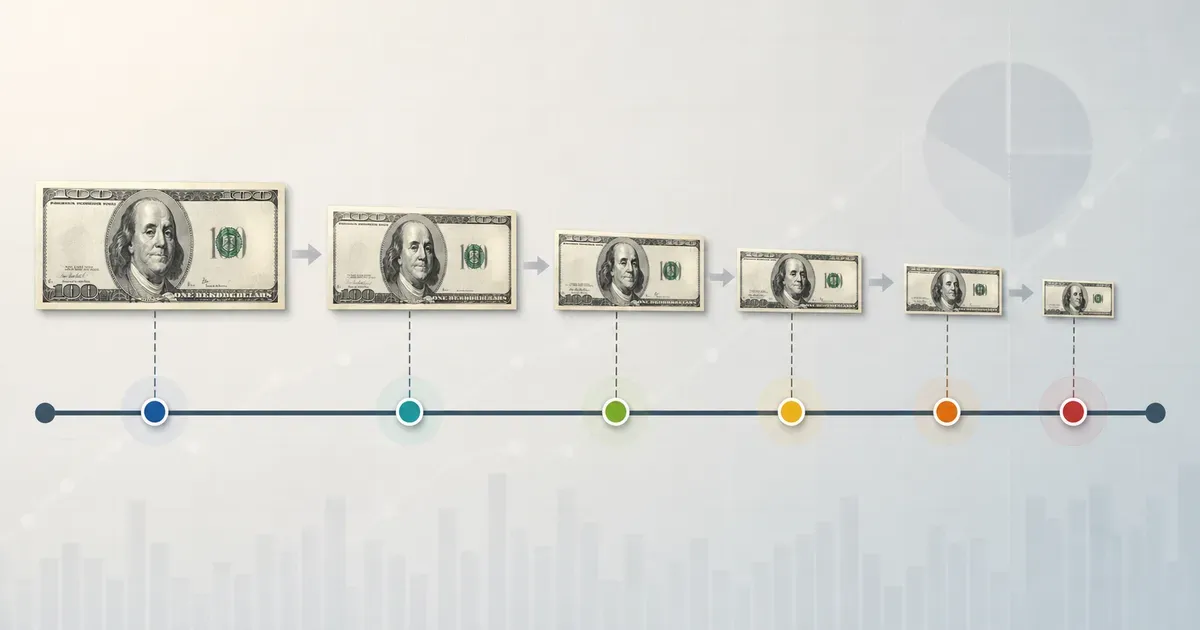
The Consumer Price Index (CPI) tracks the price of a representative "basket" of goods and services — housing, food, transportation, medical care, apparel, and more. Each month, government statistical agencies (the Bureau of Labor Statistics in the US, ONS in the UK, Eurostat in the EU) survey thousands of prices and compute how the basket's cost has changed. The percentage change over 12 months is the reported inflation rate. A CPI of 200 compared to a base-period CPI of 100 means prices have exactly doubled from the base period to today.
Why CPI Is an Approximation
The CPI basket represents an average household, not your specific spending patterns. If you spend a disproportionate share of income on healthcare (a fast-inflating category) or technology (a deflationary one), your personal inflation rate may differ substantially from headline CPI. Additionally, the basket is periodically updated to reflect changing consumption patterns, and methodology has changed several times since 1980 — meaning a direct comparison of 1980 and 2024 CPI involves some methodological apples-to-oranges. Despite these limitations, CPI remains the standard measure for broad purchasing power comparisons.
The 2021–2023 Inflation Surge
After two decades of low inflation (2000–2020 averaged ~2.2%/year in the US), the COVID-19 era produced the sharpest inflation spike since the early 1980s. US CPI peaked at 9.1% year-over-year in June 2022 before declining. The EU hit 10.6% in October 2022; UK peaked at 11.1% the same month. Cumulative US inflation from January 2020 to December 2023 was approximately 20% — meaning $100 of spending in 2020 required roughly $120 in 2023. This context is captured in the CPI data embedded in this calculator.
Purchasing Power and Wages
Purchasing power is the ratio of nominal wages to the price level. If your salary grows 3% while inflation runs at 5%, your real wage has fallen by about 2%. Wage growth consistently outrunning CPI (positive real wage growth) raises living standards; the reverse lowers them. For wage comparisons across time, use this calculator to adjust the historical wage by the CPI ratio: a $50,000 salary in 2000 is equivalent to roughly $90,000 in 2024 in purchasing power terms.
Inflation and Fixed-Income Investments
Bonds, CDs, and savings accounts pay a nominal rate. The real return is approximately: nominal rate − inflation rate. A 5% CD in a 3% inflation environment earns a 2% real return. In a 6% inflation environment, that same CD loses purchasing power. This is why TIPS (Treasury Inflation-Protected Securities) and I-bonds adjust their principal or coupon with CPI — they guarantee a real return regardless of inflation. For long-horizon savers, the inflation-adjusted return matters far more than the nominal figure printed on the account statement.
International Comparisons and Purchasing Power Parity
Different countries experience different inflation rates, driven by energy mix, monetary policy, trade patterns, and domestic demand. From 1980 to 2024, US cumulative inflation was roughly 280%; UK cumulative inflation was similar; EU cumulative inflation (from 1996 base) was about 93%. These differences matter for international salary comparisons, cross-border cost-of-living adjustments, and understanding why the same product costs different amounts in different countries. Use the country selector in this calculator to compare how the same starting amount evolved in different economies.
Planning for Inflation in Retirement
At 3% annual inflation, prices double every 24 years. A retiree on a fixed income of $60,000/year at age 65 would need $80,000/year at age 80 just to maintain the same purchasing power — a 33% increase over 15 years. Social Security benefits are CPI-indexed (COLA adjustments), but most private pensions and annuities are fixed. Use the projected mode in this calculator to stress-test retirement income assumptions: at 3.5% inflation, what does your fixed income stream look like in real terms after 20 years?
Headline vs Core Inflation: Why Central Banks Look at Both
Headline CPI includes every category in the basket, including food and energy. Core CPI strips out food and energy because their prices are volatile and largely driven by global commodity markets rather than domestic monetary conditions. Central banks like the Federal Reserve and the European Central Bank target inflation but watch core most closely for monetary policy decisions, since rate hikes can't directly affect the price of oil or wheat. For consumers, headline is what you actually pay, so the calculator uses headline CPI throughout. When commentators say inflation is "sticky" they generally mean core inflation — the slow-moving services components like rent, healthcare, and wages — has not come down even though headline has cooled.
Asset-Class Behavior During High and Low Inflation
Different assets respond differently to inflation. Cash and short-term Treasuries lose purchasing power one-for-one with CPI when nominal yields lag inflation. Long-duration bonds typically lose value in rising-inflation periods because their fixed coupons become worth less in real terms. Stocks have a mixed record: companies with pricing power and short production cycles tend to pass on costs and grow earnings with inflation, while those with long-term fixed-price contracts struggle. Real assets — residential real estate, commodities, and TIPS — are the most direct inflation hedges historically. The calculator's "projected" mode is useful here: model a fixed-income stream against expected inflation, and the same stream against an alternative inflation-protected asset, to see the real-terms gap over a 10–30 year horizon.
When Not to Use This Calculator
Historical mode only covers five economies — the United States, United Kingdom, the euro area, Canada, and Australia — using annual average CPI, not monthly or quarterly figures, so it isn't the right tool for a country outside that list or for a comparison that needs month-level precision. Projected mode is a mathematical "what if," not a forecast: entering a single assumed rate cannot capture how real inflation fluctuates year to year, so treat the projected figure as one scenario among several, not a guarantee. And because the tool works entirely in the nominal currency terms you type in, it does not convert between currencies — convert first if you're comparing purchasing power across two different currencies.
Three Worked Walkthroughs
- Grandma's savings bond, historical mode: Elena's grandmother put $100 into savings in 1980. Elena selects the US, enters $100, sets the years to 1980 and 2024, and sees the historical equivalent purchasing power today alongside the year-by-year CPI table — a concrete answer for a family conversation about "how far money used to go."
- David's retirement stress test, projected mode: David wants to know what his fixed $3,000/month pension will feel like in 20 years. He switches to projected mode, enters $3,000, an assumed 3% annual rate, 20 years, and direction "future," then compares the result against a 5% scenario to see the range of outcomes.
- Sofia's interval mode combination: Sofia wants to know what a $50,000 salary from 2005 is worth today, and then what it would need to grow to over the next 10 years at an assumed 3% rate. Interval mode chains both phases in one calculation — real CPI from 2005 to today, then a custom projection forward — instead of running two separate calculations and combining them by hand.
Inflation Calculator vs. a Spreadsheet or a Generic Online Tool
| Factor | This calculator | Spreadsheet | Generic online calculator |
|---|
| Real CPI data built in | Yes, five economies, no lookup needed | You source and paste the index yourself | Varies, often US-only or undocumented |
| Combines historical + projected | Yes, interval mode | Requires manual formulas for each phase | Rarely offered |
| Shows year-by-year breakdown | Yes | Only if you build it | Sometimes |
| Data leaves your device | Never | Never (local file) | Often, for ads or analytics |
Using Inflation-Adjusted Figures Elsewhere on This Site
Once you know how much purchasing power a goal needs in real terms, the savings goal calculator can target that inflation-adjusted amount directly using its own inflation-rate input, and the retirement calculator uses the same compounding logic to project a nest egg over decades — pairing both with this tool's projected rate keeps your assumptions consistent across every long-horizon calculation you run.
Methodological Quirks to Be Aware Of
Hedonic adjustments, owner's equivalent rent, and basket reweighting all affect how CPI is calculated and have all changed over the decades. Hedonic adjustment attempts to remove price changes that are really quality improvements: a faster computer at the same nominal price is recorded as a price decrease in the index. Owner's equivalent rent is a calculated estimate of what homeowners would pay to rent their own homes, used because direct house prices are treated as an asset, not consumption. Critics argue these methods understate true inflation, particularly for housing; defenders argue they more accurately reflect consumption costs. For most practical comparisons — wage adjustments, retirement planning, contract escalators — the published CPI is the standard reference, and that's what this calculator returns.