How This Calculator Applies APR Each Month
Many US credit card issuers use an Average Daily Balance method internally, tracking your balance every day of the billing cycle. To keep the math transparent and consistent with this site's other loan and mortgage calculators, this tool instead applies a standard monthly periodic rate — APR ÷ 12 — directly to your balance at the start of each month. For a $3,000 balance at 20% APR, that's 3,000 × (20 ÷ 100 ÷ 12) = $50.00 in interest for the month. This is the same method Truth in Lending Act disclosures use for comparing loan costs, and it will typically land within a percent or two of your actual statement, which may bill against a slightly different daily-averaged balance.
Why Minimum Payments Cost So Much
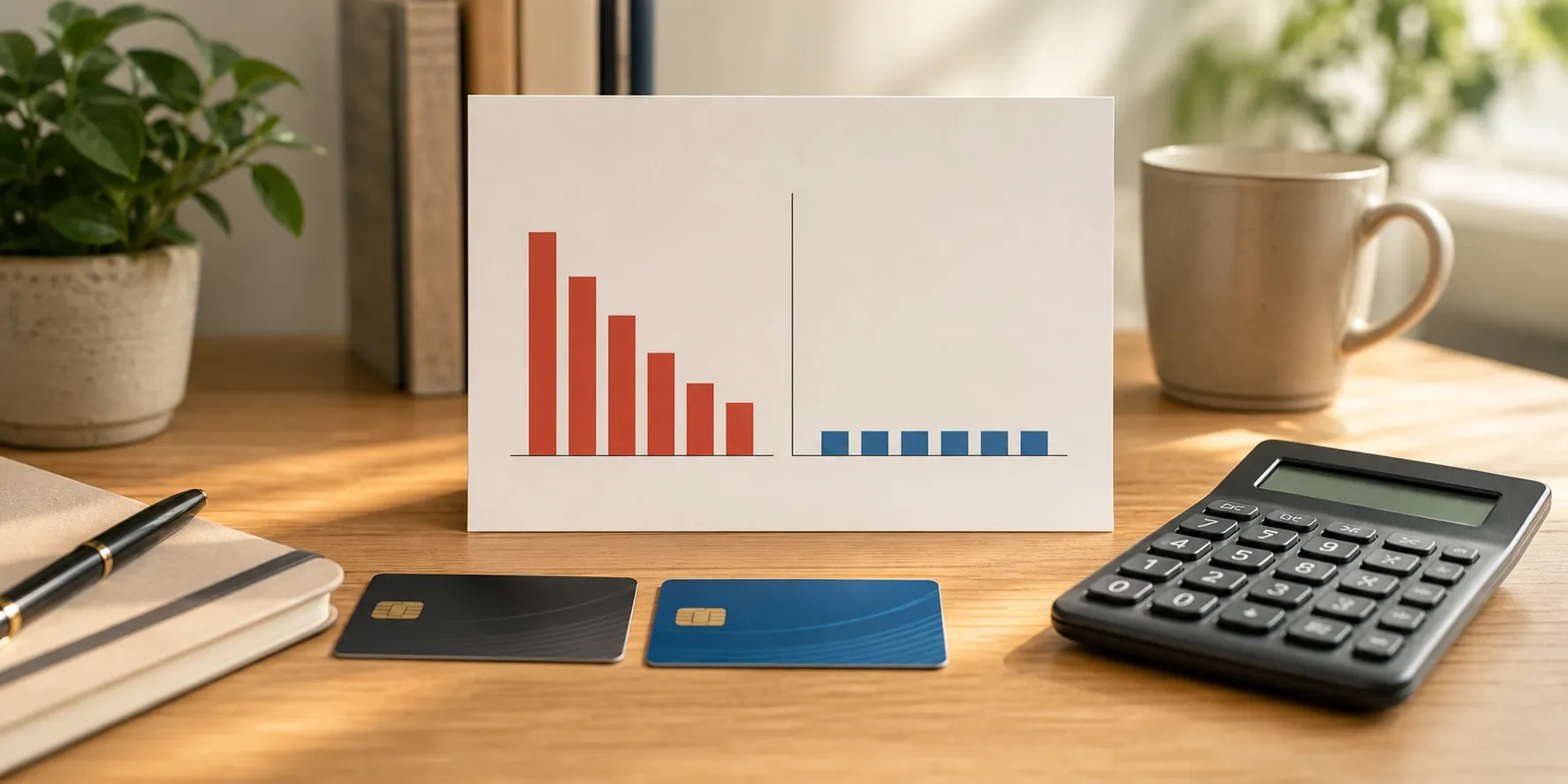
Card issuers typically set minimum payments at 1–2% of the balance (or $25, whichever is greater). On a $5,000 balance at 22% APR, the minimum payment might start at $100. Because over $90 of that goes to interest in the first month, only a few dollars reduce the principal. The balance declines slowly, and as it does, the minimum also drops — creating a treadmill effect. At minimum payments only, a $5,000 balance at 22% APR takes roughly 20 years to pay off and costs over $7,000 in interest. Paying a fixed $200/month instead cuts the time to about 3 years and saves more than $6,000.
The Power of Small Extra Payments
An extra $50 per month on a $4,000 balance at 20% APR does more than it looks: it can shorten the payoff period by 18–24 months and save $500–$800 in interest. The math works because every extra dollar of principal avoids future interest on that entire amount. This compounding benefit makes even modest increases in payment size highly efficient at high interest rates. The what-if table in this calculator lets you see the exact numbers for your specific balance and rate.
Carrying a Balance vs Paying in Full
Credit cards are a zero-interest loan if you pay the full statement balance each billing cycle — grace periods typically run 21–25 days after the statement closes. The moment you carry even a small balance forward, you lose the grace period on new purchases, and interest begins accruing immediately. This is why many financial advisors treat credit card debt reduction as effectively a guaranteed return equal to the card's APR — paying off a 22% APR card is the equivalent of earning a guaranteed 22% on that money, after tax.
Balance Transfers: Do the Math First
A 0% APR balance transfer offer can save significant interest — but transfer fees (typically 3–5%) and the limited promotional period (usually 12–21 months) change the calculation. For a $5,000 transfer with a 3% fee, you pay $150 upfront. If the promo period is 18 months, you need to pay roughly $278/month to clear the balance before interest kicks in. Use this calculator to model the payoff under the promo rate and then check whether you can realistically make that payment before committing to the transfer.
APR vs Interest Rate: What's the Difference?
For credit cards, the APR and interest rate are effectively the same because fees are typically disclosed separately. For mortgages and personal loans, the APR is wider — it includes origination fees, discount points, and other costs rolled into a single annual rate for comparison purposes. Always use APR when comparing credit card offers; it is the legally mandated uniform disclosure that lets you compare across issuers on equal footing.
When to Consider Professional Help
If your total minimum payments exceed 20–25% of your take-home income, or if you cannot make more than the minimum on multiple cards, a nonprofit credit counseling agency (look for NFCC members) can sometimes negotiate reduced interest rates through a debt management plan. This is different from debt settlement, which involves missing payments and damages your credit. A debt management plan is typically a structured multi-year payoff at a reduced rate — model the proposed payment with this calculator to verify it fits your budget and compare it to the unassisted payoff timeline.
Promotional APR vs Purchase APR vs Cash Advance APR
A single credit card often carries three or more interest rates. The purchase APR applies to ordinary spending; the promotional APR is what you see in welcome offers and is time-limited; the cash advance APR is typically 5–10 points higher than the purchase APR and accrues interest from day one with no grace period. Balance transfer APRs are a fourth tier. When you carry mixed balances, issuers must apply payments above the minimum to the highest-rate balance first under the CARD Act, but the minimum payment portion can be applied to lower-rate balances — keeping the cash advance balance accruing interest longer than you might expect. The cleanest strategy is to avoid cash advances entirely and to never let promotional balances roll into a regular APR period.
Practical Payoff Strategies for Different Income Levels
If your card balance is small relative to your income — say, under one month of take-home pay — the most efficient path is usually to throw everything you can at it for one or two months and then resume normal saving. For mid-sized balances of two to six months of income, a structured 12–24 month payoff plan with a fixed monthly amount is more sustainable; the calculator's fixed-payment mode is designed for exactly this case. For balances above six months of income, the math alone may not be enough — combining a balance transfer (if you qualify), a temporary reduction in discretionary spending, and an increase in income through side work often becomes necessary. In all three cases, build a small starter emergency fund of $500–$1,000 first so an unexpected expense doesn't force you back onto the card mid-payoff.
How This Calculator Differs from Your Statement
Your monthly statement shows interest accrued during a specific billing cycle of 28–31 days, computed by many issuers against an average daily balance that includes mid-cycle payments and new purchases. This calculator instead applies a flat monthly periodic rate to the balance at the start of each month, assuming no new purchases and a single payment per period. The result is typically within 1–3% of your statement total over a multi-month payoff. If you continue to use the card while paying it down, the actual payoff will be slower than the calculator predicts — a common reason real-world payoffs run long. To match the model exactly, freeze the card or move it out of your wallet for the duration of the payoff.
When Not to Use This Calculator
This tool models a single card, with either a constant fixed monthly payment or a fixed payoff timeline — it does not track a real "minimum payment only" plan, where the required minimum typically shrinks as your balance drops, stretching the true payoff longer than a level fixed-payment schedule shows. If you genuinely intend to pay only the minimum, use your card's current minimum as the fixed payment for a rough, optimistic estimate, and expect the real timeline to run longer. It also does not include annual fees, late fees, or a variable rate that changes mid-schedule — re-run the calculator with an updated APR if your rate changes. And for balances split across more than one card, this tool intentionally handles one card at a time; the debt payoff calculator is built for comparing snowball and avalanche strategies across multiple balances.
Three Worked Walkthroughs
- Minimum-only vs. fixed $250, one card: Jamal has a $4,500 balance at 22% APR. Paying only the card's roughly 2%-of-balance minimum stretches payoff to well over a decade; switching to a fixed $250/month in this calculator's fixed-payment mode cuts that to just over two years and shows the exact interest saved — the what-if table lets him compare $200, $250, and $300 side by side before committing.
- Target-date planning: Renata wants her $2,800 balance at 19.99% APR gone in exactly 18 months for a specific savings goal. She switches to fixed-months mode, enters 18, and gets the exact required monthly payment instead of guessing and checking.
- Two cards, avalanche by hand: Marcus has a $3,000 balance at 24.99% APR and a $6,000 balance at 16.9% APR. He runs this calculator separately for each card to see each one's own payoff timeline and interest cost, confirming the avalanche method — extra payments to the higher-rate $3,000 card first — is worth it before using the debt payoff calculator to model both balances together as a single avalanche or snowball plan.
Credit Card Payoff Calculator vs. a Spreadsheet or a Generic Payoff Widget
| Factor | This calculator | Spreadsheet | Generic search-result widget |
|---|
| What-if extra-payment comparison | Built in, several amounts at once | Requires separate formulas per scenario | Rarely offered |
| Full amortization schedule | Yes | Only if you build it | Sometimes summarized only |
| Card offers or referrals shown | Never | Never | Often |
| Data leaves your device | Never | Never (local file) | Often, for ads |
After the Card Is Paid Off
Once you know your monthly payment amount here, redirecting that same amount is one of the fastest ways to hit a savings target: the savings goal calculator shows how quickly a former card payment builds an emergency fund or a specific goal, and if the payoff plan freed up room in your budget, the salary calculator helps translate that monthly figure against your actual take-home pay.