
Saving for a car sits in an awkward middle ground. It is far bigger than the vacation or new-laptop goals most saving advice assumes, but nowhere near the multi-year commitment of a house. That in-between size is exactly why so many people drift into financing a car they could have partly saved for — they never set a concrete target, so the dealership sets it for them. This guide walks through the opposite approach: deciding the real amount you need, choosing a timeline you can sustain, and translating both into a weekly or monthly deposit you will actually keep. The Savings Goal Calculator runs the arithmetic instantly, but understanding how the pieces fit together is what lets you set a target you will still be hitting six months from now instead of quietly abandoning.
Start With the Total Cost, Not the Sticker Price
The single most common mistake in a car savings plan is anchoring to the advertised price and forgetting everything stacked on top of it. The number on the windshield is not the number you need in the bank. Before you set a target, add up the full cost of driving the car off the lot: the sale price plus sales tax, title and registration fees, and any dealer documentation charges. Sales tax alone varies widely by location and can add several hundred to a couple of thousand dollars to a modest purchase, so treat it as a real line item rather than an afterthought.
A simple planning approach works well here: take the sticker price and add a rough allowance — commonly on the order of 8 to 10 percent as an illustrative estimate — for tax, title, registration, and fees, then confirm the actual rate for your area before you commit. On a $16,000 used car, that pushes the true target closer to $17,300–$17,600. Setting your goal at the honest total rather than the sticker is what stops you from reaching your target date and discovering you are still a thousand dollars short of driving anything home. Fix the amount first, and every later number falls out of it correctly. For the general discipline behind this step, our guide on how to set a realistic savings target walks through pricing a goal and subtracting what you already have.
New vs Used: Two Very Different Targets
The new-versus-used decision reshapes your entire savings plan, because it changes the size of the target more than almost anything else you can control. A new car carries the steepest depreciation in its first two or three years — a cost you pay simply by being the first owner. A well-chosen used car of the same model, a few years old, can cost a large fraction less while doing the identical job of getting you to work. From a pure savings standpoint, a lower target is a shorter timeline, a smaller monthly deposit, or both.
This is where saving for a car quietly diverges from saving for a home. A house tends to appreciate while you save, which pushes you to target a future price and hurry; see our companion walkthrough on planning a house down payment for how that inflation adjustment works. A car does the reverse — it loses value over time — so there is no penalty for taking a sensible amount of time to save, and often a real reward for buying slightly older. Deciding new versus used is really deciding how large a target you are signing up for, so make that call before you pick a timeline.
Down Payment or Full Cash?
Your next decision is whether you are saving the entire purchase price or only a down payment. Both are legitimate; they simply produce very different targets.
Saving the full amount
Paying cash means no loan, no interest paid to a lender, and no monthly car payment eating into your budget for years afterward. The trade-off is a larger target and usually a longer runway. If you want an $18,000 used car outright and give yourself two years, that is $18,000 over 24 months, or $750 per month. Framed weekly across roughly 104 weeks, it is about $173 a week. The full-cash route asks more of you up front but leaves you owning the car free and clear the day you buy it.
Saving a down payment
If you plan to finance part of the purchase, your savings target shrinks to the down payment plus those upfront taxes and fees. A larger down payment means borrowing less, paying less interest over the life of the loan, and often qualifying for better terms. Suppose you are buying a $32,000 new car and aim to put 20 percent down: that is a $6,400 target. Save it over 18 months and you need about $356 per month. The down-payment path gets you into the car sooner with a smaller savings goal, at the cost of carrying a loan afterward. The right choice depends on how quickly you need the car and how comfortable you are with monthly payments — but either way, the calculator lets you model both targets side by side so the decision is explicit rather than assumed.
Turn the Target Into a Weekly or Monthly Number
Once the amount is set, the plan becomes real only when you express it as a per-period deposit. The same target can be framed weekly or monthly, and the right unit is simply whichever matches how you are paid and how you think. Monthly framing slots cleanly into a budget built around rent and bills; the $6,400 down payment above is $356 a month over 18 months. Weekly framing makes the same commitment feel smaller and closer to a weekly paycheck — the $18,000 full-cash target is about $173 a week, which many people find easier to hold in their head than its $750 monthly twin.
You can also flip the calculation around. Instead of fixing the deadline and solving for the deposit, fix the deposit you can comfortably afford and let the tool tell you the date you will reach the goal. If you know you can spare $300 a month toward a $9,000 used car, that answers "when" rather than "how much": roughly 30 months, ignoring interest. Seeing the date on a calendar is often more motivating than seeing the monthly figure, because it turns an open-ended intention into a specific finish line.
The Timeline Is Your Main Lever
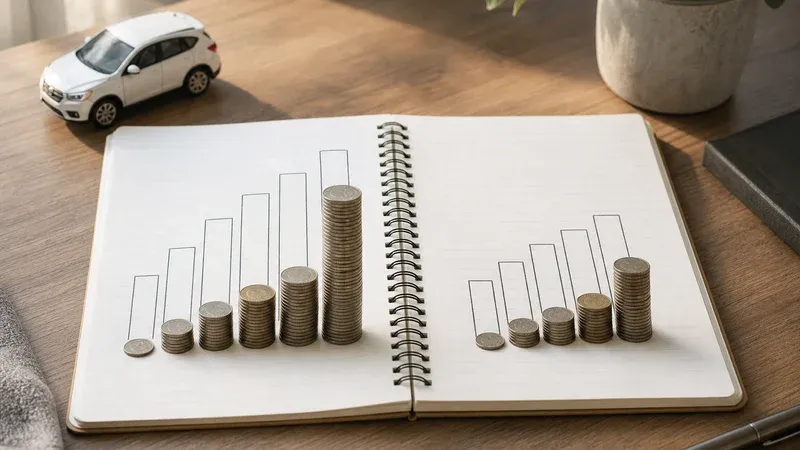
When the required deposit comes back higher than you can manage, the timeline is almost always the gentlest thing to adjust. Because the contribution is roughly the target divided by the number of periods, stretching the deadline shrinks each deposit close to proportionally. A $15,000 target shows it cleanly, setting interest aside for a moment: over one year that is $1,250 a month; over two years, $625; over three years, about $417. Doubling the time roughly halves the monthly ask.
Unlike a house tied to a lease renewal or a tuition deadline, a car goal is usually flexible on timing — which makes the timeline your best release valve when the numbers feel tight. If $625 a month is a stretch, giving yourself an extra year drops it toward $417 without touching your income or your budget. The one real constraint is your current vehicle: if it is on its last legs, you may not have the luxury of a leisurely timeline, and that pressure is itself a reason to keep an older, cheaper car running a little longer while you save. When you genuinely cannot extend the deadline, the other levers are trimming the target — a less expensive model, a slightly older year, a smaller down payment — or finding room in your budget. Testing those trade-offs on paper, before you are standing in a showroom, is far cheaper than discovering them after you have already committed.
Let Interest Trim the Monthly Figure
If you keep your car fund somewhere that pays interest, the account contributes alongside you and your required deposit drops. On a short one-year goal the effect is small — often just a few dollars a month — so treat the straight-line "amount divided by months" figure as your realistic baseline and let any interest be a modest bonus. On a longer goal the effect grows into real money. Consider a $24,000 target over four years. Straight-line, that is $500 a month. In a high-yield savings account earning around 4 percent APY — illustrative, since these rates are variable and move with the wider rate environment — the required deposit falls to roughly $462 a month, because the interest earned along the way supplies the rest. Over the four years you would contribute about $22,180 of your own money and let interest cover the remaining ~$1,820 of the target.
Two practical notes. First, because a car is money you will spend on a fixed-ish date, keep the fund somewhere principal-protected and liquid — a high-yield savings account or money market fund, not the stock market, where a bad quarter right before you buy could leave you short. Second, model your plan with the rate of the account you will actually open, not an optimistic figure, so the projection matches reality. Interest helps most on the longer, larger targets; on the quick ones, discipline does nearly all the work.
Don't Forget the Cost of Owning the Car
A realistic car savings plan looks slightly past the purchase itself, because the day you buy the car is the day a set of recurring costs begins. Insurance is the big one: a lender financing the purchase will typically require full coverage, and even paid-in-full owners need at least the minimum coverage their region mandates. Registration renewals, routine maintenance, fuel or charging, and the occasional repair all land after the sale. These are not part of your savings target — you are not saving a lump sum for them — but they belong in the budget you use to decide how much you can spare each month for the target in the first place.
The reason this matters for saving is that a car you can barely afford to buy is often a car you cannot comfortably afford to own. Building a small cushion into the plan — committing perhaps 80 to 90 percent of your available surplus to the car fund rather than every last dollar — leaves room for the insurance premium and the first oil change without forcing you to raid the savings you just built. A target that consumes 100 percent of your slack only works in a month where nothing else goes wrong, and those months are rarer than we like to admit.
Save for a Car in Five Steps
- Price the true total. Start from the sticker of the specific car you want, add tax, title, registration, and fees, and use that honest number as your target — not the advertised price.
- Choose new vs used and cash vs down payment. These two decisions set the size of the goal more than anything else. A used car and a down-payment-only target both shrink the number dramatically.
- Pick a sustainable timeline. Divide the target by the months you are giving yourself, then sanity-check the deposit against the surplus that survives an ordinary month, reserving 10–20 percent as breathing room.
- Choose your unit and run it both ways. Open the Savings Goal Calculator, view the target as a weekly or monthly amount, and flip it to see the date a comfortable deposit would reach. Add the interest rate of the account you will actually use for longer goals.
- Automate and adjust. Schedule a transfer into a separate car fund the day after payday, then revisit each quarter — extend the timeline or trim the model if you fall behind, or pull the date forward if you race ahead.
Saving for a car is not about summoning heroic discipline for an enormous number; it is about setting an honest target, choosing a timeline you can hold through an ordinary year, and letting an automated transfer do the rest. Decide new versus used and cash versus down payment on purpose, price the full cost including tax and fees, and translate it into the weekly or monthly deposit you are most likely to keep. Model your own goal in the Savings Goal Calculator, pick the framing that fits your paycheck, and let a target you chose deliberately carry you to the day you drive off having paid for it your way.