
"How much car can I afford?" is the wrong question if you only look at the sticker price or the monthly payment a dealer quotes. Affordability is a relationship between three numbers: how much you put down, how long you borrow, and how large the total cost of driving is relative to your income. The 20/4/10 rule is a widely cited rule of thumb that ties all three together into one simple test. This guide explains what the rule means, walks through the payment-to-income math, shows why long loan terms create negative equity, and demonstrates how your down payment changes what you can responsibly buy. It pairs directly with the Car Loan Calculator, which lets you plug in your own numbers and test the rule in seconds.
What the 20/4/10 Rule Actually Says
The 20/4/10 rule is a guideline, not a law or a lender requirement. It is promoted by major banks and auto-finance educators as a quick sanity check before you sign. It has three parts:
- 20 — Put at least 20% down. A down payment of one fifth of the purchase price reduces the amount you finance and, critically, gives you equity from day one.
- 4 — Finance for no more than four years (48 months). A shorter term means you pay less interest overall and pay the loan down fast enough to stay ahead of depreciation.
- 10 — Keep total transportation costs at or below 10% of your gross monthly income. As Chase and other lenders describe it, the 10% is based on gross (pre-tax) income, and "total transportation costs" means the loan payment plus insurance, fuel, and maintenance — not the payment alone.
That last point is where most buyers get it wrong. They compare only the monthly payment to their budget and forget that insurance, gas, and upkeep can add hundreds of dollars a month. The 20/4/10 rule forces you to budget for the whole cost of driving.
The 10% Test: Payment-to-Income Math
Start with your gross monthly income — your pay before taxes and deductions. Multiply by 10% (divide by 10). That figure is your entire monthly transportation budget. Then subtract your other car costs to find how much is left for the loan payment itself.
Consider a household earning $80,000 per year, which is about $6,667 gross per month:
- 10% of gross monthly income: $667 — the total transportation budget
- Estimated insurance: $160/month
- Estimated fuel: $130/month
- Estimated maintenance and repairs: $60/month
- Remaining for the car payment: $667 − $350 = $317/month
A $317 monthly payment at a 7% APR over 48 months finances roughly $13,300 in principal. Add the required 20% down payment, and this household is looking at a total vehicle price of about $16,500. That may feel low against today's average transaction prices — and that is exactly the point of the rule. It reveals the gap between what dealers will approve you for and what actually fits your budget without crowding out savings, rent, and everything else.
The 20/4/10 Rule at Three Income Levels
The clearest way to see how the rule scales is to run it at three household incomes, holding the same assumptions: a 7% APR over a 48-month term, 20% down, and realistic estimates for insurance, fuel, and maintenance that grow modestly with the price of the car. Each example converts 10% of gross monthly income into a total transportation budget, subtracts the running costs to find the room left for the payment, then works backward to the maximum car price. The arithmetic is the article's own — no market averages are assumed.
- $40,000 income ($3,333/month gross): transport budget = $333. Estimated running costs on a modest used car — insurance $95, fuel $90, maintenance $45 — total $230, leaving about $103 for the payment. At 7% over 48 months that finances roughly $4,300; with 20% down the maximum price is about $5,400. The rule is genuinely tight here, and it is telling you a reliable used car, not a new one, is the affordable choice.
- $75,000 income ($6,250/month gross): transport budget = $625. Running costs of insurance $150, fuel $120, maintenance $60 total $330, leaving about $295 for the payment. That finances roughly $12,300; with 20% down the maximum price is about $15,400 — a solid late-model used vehicle.
- $120,000 income ($10,000/month gross): transport budget = $1,000. Running costs of insurance $175, fuel $140, maintenance $70 total $385, leaving about $615 for the payment. That finances roughly $25,700; with 20% down the maximum price is about $32,100.
Two patterns stand out. First, the affordable car price rises faster than income because the fixed running costs consume a smaller share of the budget as income grows. Second, at every level the number lands below what a dealer would happily approve. Run your own figures in the Car Loan Calculator to find your line.
The 4-Year Term: Why Long Loans Backfire
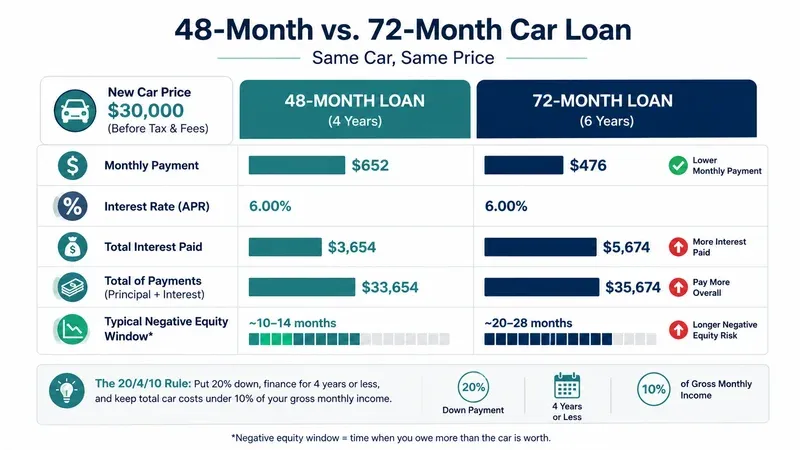
Stretching a loan term lowers the monthly payment, which is why 72- and 84-month auto loans have become common. But a longer term increases total interest and — more dangerously — keeps you "underwater" for years. Take the same car financed at 7% APR:
- 48-month term: about $718/month on a $30,000 loan, roughly $4,500 total interest
- 72-month term: about $512/month on the same $30,000 loan, roughly $6,800 total interest
The 72-month loan saves about $206 a month but costs roughly $2,300 more in interest — and it takes far longer to build equity. This is not just a math problem; it is a documented consumer risk. The Consumer Financial Protection Bureau warns that "a longer loan puts you at risk for negative equity over a longer period of time," where negative equity means you owe more on the vehicle than it is worth.
Why Long Terms Cause Negative Equity
A new vehicle loses value quickly — commonly around 20% in the first year alone. On a short loan with a solid down payment, your balance falls faster than the car depreciates, so you keep positive equity. On a long, low-down-payment loan, the balance falls slowly while the car keeps depreciating, so for a stretch of the loan you owe more than the car is worth.
The CFPB's analysis of auto-finance data found that negative equity is widespread and rising: across loans originated between 2018 and 2022, roughly 11.6% of vehicle loans included negative equity rolled in from a prior trade-in, peaking at over 17% in 2020. The Bureau also reported that by late 2023, about one in five vehicles traded in carried negative equity. Most importantly, the CFPB found that consumers who financed negative equity were more than twice as likely to have their loan sent to repossession within two years compared with buyers who traded in a car with positive equity.
The 4 in 20/4/10 exists to keep you out of this trap. A 48-month payoff on a car with 20% down keeps your equity positive through almost the entire loan, so you can sell or trade without writing a check to cover the shortfall. If you later end up rolling an old balance into a new loan, model it first with the trade-in and negative-equity guide so you can see the real cost before signing.
How the Down Payment Changes Affordability
The 20% down payment does more than shrink the monthly payment — it changes your entire equity position and your risk exposure. Compare a $35,000 car financed at 7% APR over 48 months:
- 0% down (finance $35,000): about $838/month, roughly $5,200 total interest, and you are underwater from the moment you drive off the lot.
- 20% down ($7,000, finance $28,000): about $670/month, roughly $4,200 total interest, and you start with meaningful equity that cushions against depreciation.
The 20% down payment cuts the monthly cost by roughly $168, saves about $1,000 in interest, and — the part that never shows up on the dealer's worksheet — protects you if the car is totaled early. Insurance pays the car's market value, not your loan balance, so a small down payment on a long loan can leave you owing money on a car you no longer have. GAP insurance covers that gap but adds cost; a healthy down payment reduces the need for it.
If you cannot reach 20% down on the car you want, the honest conclusion is usually that the car is too expensive for your situation right now, not that the rule is wrong. Buying a less expensive vehicle to hit 20% down is almost always cheaper than adding GAP insurance and stretching the term on a pricier one.
What the Rule Leaves Out
The 20/4/10 rule is a strong first filter, but it treats insurance, fuel, and maintenance as single monthly estimates. In reality those three costs vary enough that two buyers with identical incomes and identical cars can have very different true costs of ownership.
- Insurance varies widely. Premiums depend on your driving record, age, location, coverage level, and the specific vehicle — sports cars and models with expensive parts cost more to insure than economy sedans. When you plug a number into the 10% test, use a real quote for the exact car, not a generic estimate, because the difference can swing your available payment room by a hundred dollars a month.
- Maintenance climbs as cars age. A three-year-old car under warranty may need little beyond oil, tires, and brakes. A ten-year-old car can need timing components, suspension work, or a major service in any given year. If you buy older to hit the price target, budget a larger maintenance line — the lower purchase price is partly offset by higher upkeep.
- Electric vehicles shift the cost mix. EVs typically have lower fuel and maintenance costs — no oil changes, fewer moving parts, and electricity that is usually cheaper per mile than gasoline — but a higher purchase price and, for many owners, the one-time cost of installing a home charger. Running an EV through the rule, the fuel and maintenance lines shrink while the price line grows, so the payment can dominate the budget even though day-to-day driving is cheaper.
None of these break the rule; they refine it. The discipline the rule enforces — budget for the whole cost of driving, not just the payment — is exactly what makes these variables visible before you sign.
When the 20/4/10 Rule Is Hard to Meet
The rule was calibrated for a car market with lower prices than today's. With average new- and used-car prices well above where they sat a decade ago, and financing rates for new-car loans hovering in the high-6% to 7% range in 2026 according to the Federal Reserve's G.19 data and lender rate surveys, many buyers find the 10% ceiling difficult to hit. Some financial commentators now suggest a more realistic target of roughly 12% to 15% of gross income for total transportation costs when the strict 10% is out of reach.
Treat that as a flex, not a free pass. Every percentage point you add to the transportation share is a percentage point that cannot go toward rent, retirement, or an emergency fund. If you must go above 10%, keep the 20% down and the four-year term intact — those two guardrails are what protect you from negative equity and repossession risk. The income share is the part that flexes; the down payment and term are the parts that keep you safe.
When It's Reasonable to Break the Rule
A rule of thumb earns trust by being honest about its exceptions. There are situations where sensibly stepping outside 20/4/10 is defensible:
- Cash buyers. If you pay in full, the "4" (loan term) is irrelevant and there is no negative-equity risk, because you never owe anything. The 10% total-cost test still matters — a paid-off car you cannot afford to insure and fuel is still a strain — but the financing guardrails simply do not apply.
- Very short or very cheap commutes. If you drive few miles, work from home, or live somewhere with cheap parking and fuel, your running costs are lower, which frees up room in the 10% budget for a slightly larger payment without breaking the total-cost ceiling.
- Business-use vehicles. When a vehicle is genuinely used for a business, some ownership costs may be deductible, which changes the after-tax math (treat this as a concept and confirm the specifics with a tax professional and current rules — do not assume a deduction). That can justify a different budget than a purely personal car.
- Avoid the reverse temptation. The one exception that almost never pays off is stretching the term to buy a faster-depreciating car. High-depreciation vehicles combined with long loans are the classic recipe for deep negative equity — precisely what the 4 exists to prevent.
20/4/10 vs Other Affordability Rules
The 20/4/10 rule is not the only shortcut in circulation. Two others show up often: a "total price under 35% of gross annual income" rule, and a "payment under 15% of take-home pay" rule. Each optimizes for something different.
| Rule | Down payment | Term | What it optimizes for |
|---|---|---|---|
| 20/4/10 | At least 20% | 48 months max | Staying in positive equity and capping the total cost of driving, not just the payment |
| Price ≤ 35% of gross annual income | Not specified | Not specified | A quick ceiling on the sticker price; ignores financing terms, insurance, and running costs, so it can still hide an unaffordable payment |
| Payment ≤ 15% of take-home pay | Not specified | Not specified | Cash-flow comfort on the monthly payment alone; says nothing about equity, term length, or the ancillary costs of ownership |
The trade-off is clear: the 35% and 15% rules are simpler but silent on the two things that cause the most financial damage — long terms and total running cost. 20/4/10 is stricter precisely because it addresses both. If you use one of the simpler rules, pair it with the discipline of a 20% down payment and a term no longer than 48 months to cover the blind spots.
Putting the Rule to Work With the Calculator
The fastest way to apply the 20/4/10 rule to a specific car is to test it directly. In the Car Loan Calculator, enter the vehicle price, set the down payment to 20% of that price, set the term to 48 months, and enter a realistic APR for your credit tier. The calculator returns the monthly payment, total interest, and full amortization schedule. Then check the payment against your 10% transportation budget after subtracting insurance, fuel, and maintenance. If the payment fits, the car passes the rule. If it does not, you have three levers: a bigger down payment, a cheaper car, or — as a last resort — a longer term, with the negative-equity cost that comes with it.
For the mechanics of how APR, term, and down payment interact on any auto loan, see the companion car loan guide. Used together, the guide, this rule, and the calculator turn "how much car can I afford?" from a gut feeling into a number you can defend.