
Why Splitting the Check Causes Friction
Few moments end a nice dinner more awkwardly than the arrival of the bill for a group. Someone had a steak and two cocktails, someone else had a salad and water, and now the table has to decide who owes what — including tax and tip — under social pressure and often with tired mental math. This guide covers the three fair ways to split a restaurant bill, how to handle tax and tip correctly, and how to settle up in seconds. When you are ready to run the numbers, our free Tip Calculator handles the tip and per-person split instantly in your browser.
Method 1: The Even Split
The simplest approach: add tip to the total and divide by the number of people. It works beautifully when everyone ordered roughly the same, and it is fast — no itemizing, no debate. The math is (bill + tip) ÷ people. On a $120 bill with a 20% tip, the total is $144; split four ways that is $36 each.
The even split's only weakness is fairness when orders differ a lot. Among close friends it usually does not matter — it evens out over many dinners — but with acquaintances or a one-off group, the person who had water may quietly resent subsidizing the person who had the wine pairing. Read the table: if orders were similar, split evenly and move on.
Method 2: Split by Item (Proportional Tip)
When orders differ significantly, the fair approach is for each person to pay for what they ordered, plus a proportional share of the tax and tip. The key insight is that tax and tip should scale with what each person spent, not be divided equally.
Here is the method: total each person's own items to get their subtotal. Then allocate the tip in proportion to that subtotal. If your share of the food was 25% of the subtotal, you pay 25% of the tip. In formula terms, your total = your items + (your items ÷ subtotal) × total tip. This keeps the split precise and defensible: the big spender covers a bigger slice of the tip, exactly as they should.
The one thing to avoid is splitting the items unevenly but the tip evenly — that quietly overcharges the light eaters. Proportional tip is the honest version of "pay for what you had."
Method 3: The Hybrid
Real dinners are often somewhere in between. A common, low-friction compromise: split shared plates and bottles evenly, and assign clearly individual items (a pricey entrée, a solo dessert) to whoever had them. Then add tip proportionally to each person's resulting subtotal. This respects both the communal nature of shared dishes and the fairness of individual ordering, and it avoids litigating every appetizer.
Handling Tax and Tip Correctly
Two rules prevent most disputes:
- Scale tax and tip with spending. Whether you split by item or hybrid, tax and tip should follow each person's subtotal, not be divided per head. Dividing tip equally while splitting items individually is the most common unfair mistake.
- Tip on the pre-tax subtotal if you want to be precise, though tipping on the post-tax total is common and only slightly more generous.
Rounding Without a Shortfall
Rounding is where split bills silently go wrong. If each person rounds their share down, the cash collected can fall short of the bill, and someone — usually the organizer — quietly covers the gap. The fix is to round the total up first, then divide. Consider a $47.70 total split three ways: rounding per person to $15.90 gives 3 × $15.90 = $47.70 (fine here), but a $48.20 total rounded per person to $16.06 gives $48.18 — two cents short. Rounding the total up to $48.30 or $49 guarantees the amounts cover the check. A good calculator rounds the total up to your chosen increment for exactly this reason, and shows the effective tip the rounding produced.
Settling Up Quickly
- Pick a method before the bill arrives. Agreeing "let's just split evenly" or "everyone covers their own" up front removes the awkward negotiation.
- Use one card and reimburse. One person pays the whole bill on a card and everyone sends their share by a payment app. It is faster than asking the server for separate checks and often nets card rewards.
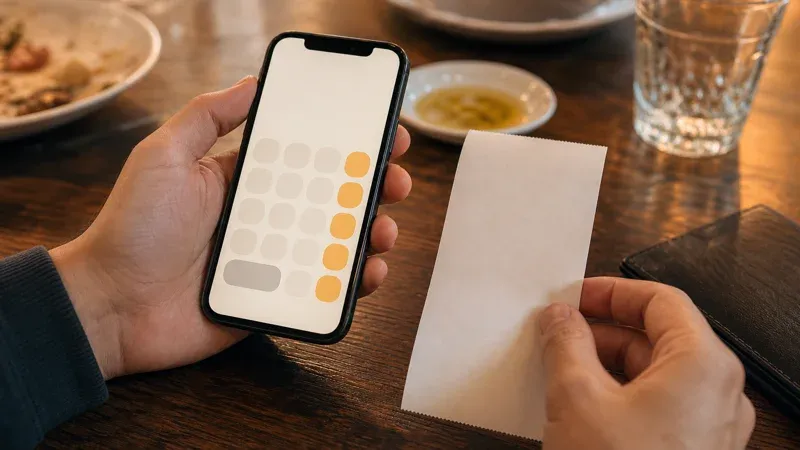
- Do the math on a phone, not in your head. Enter the bill, choose the tip, set the number of people, and read off the per-person amount. It shows everyone the same fair number and ends debates before they start.
- Watch for an added service charge. Large groups are often charged an automatic 18–20% gratuity — do not tip again on top of it.
Handling the Tricky Cases
A few situations trip up even a well-agreed split, and knowing them in advance keeps the peace. The non-drinker. When one person abstained from a shared bottle of wine or a round of cocktails, it is fair — and increasingly expected — to pull alcohol out of the shared pool and split only the food evenly, then let the drinkers cover the bar tab. Alcohol is often the single biggest driver of an "unfair" even split, so isolating it solves most of the perceived injustice with one adjustment.
The person who "wasn't that hungry." Someone who ordered only an appetizer should not subsidize entrées, but they also should not nickel-and-dime a $6 difference among close friends. A good rule of thumb: if the gap between the lightest and heaviest order is small (say, under 20% of the average), split evenly; if it is large, split by item. Reserve the itemized approach for genuine mismatches, not minor ones.
The organizer who booked and paid the deposit. If one person fronted a reservation deposit or a set-menu prepayment, subtract that from their share before splitting the remainder, so they are reimbursed first. Forgetting this is a common way the person who did the work ends up quietly out of pocket.
Currency and cash-versus-card abroad. Traveling groups often face a bill in one currency, a card that charges in another, and a server who prefers a cash tip. The cleanest approach is for one person to pay the whole bill by card at the real exchange rate and have everyone reimburse in the group's home currency by app, adding any cash tip separately. Trying to split a foreign-currency bill in cash at the table almost always produces rounding losses and confusion.
The recurring group. For friends who eat together often, the fairest long-run system is frequently the simplest: split evenly every time and let it average out, or rotate who pays the whole bill. Both avoid the slow social cost of itemizing every dinner, which can make a regular meetup feel transactional. Save the precise split for one-off gatherings and larger, less familiar groups.
A Worked Example
Four friends have a $160 bill. Two ordered modestly ($25 and $30 of food), two more lavishly ($45 and $60). They want a 20% tip. The subtotal is $160, so the tip is $32, for a $192 total. An even split is $48 each — simple, and the light eaters overpay by roughly $14 each. A proportional split assigns the tip by share: the $25 diner pays $25 + (25/160 × $32) = $30; the $60 diner pays $60 + (60/160 × $32) = $72. Everyone pays for what they had plus their fair share of the tip, and the four amounts still sum to $192. Which method you choose depends on the group — but now you can compute either one in seconds.
Apps and Etiquette
Payment apps have quietly solved the mechanics of splitting, but not the etiquette. The technical part is easy: one person pays, everyone else sends their share in seconds, and no one has to find exact change or ask the server for five separate checks. The social part still takes a little grace. Send your share promptly rather than making the organizer chase you — a bill everyone settles that night is a bill no one resents a week later. If you are the one who paid, state the per-person number clearly and without drama, and round in everyone else's favor by a few cents rather than your own; the goodwill is worth more than the small amount. And avoid turning every meal into a spreadsheet: the goal of splitting fairly is to make money a non-issue so the evening stays about the company, not the arithmetic. A quick calculation, a clear number, and a prompt transfer keep the focus where it belongs.
Conclusion
Splitting a restaurant bill fairly comes down to three choices — even, by item with proportional tip, or a hybrid — plus one rule that prevents disputes: scale tax and tip with what each person spent, and round the total up so the group never comes up short. Decide the method before the check lands, let one person pay and get reimbursed, and use a calculator so everyone sees the same number. Try it now with the free, private Tip Calculator and make the end of dinner the easy part.
References and Further Reading
- IRS — Tip recordkeeping and reporting — confirms that a mandatory, automatically-added charge (such as the automatic gratuity large groups are often charged) is a service charge, not a voluntary tip, supporting the "watch for an added service charge" guidance above.
- U.S. Department of Labor — Fact Sheet #15: Tipped Employees Under the FLSA — background on the US tipped-wage structure that underlies why tipping on the bill is treated as expected, not optional, in American restaurants.